
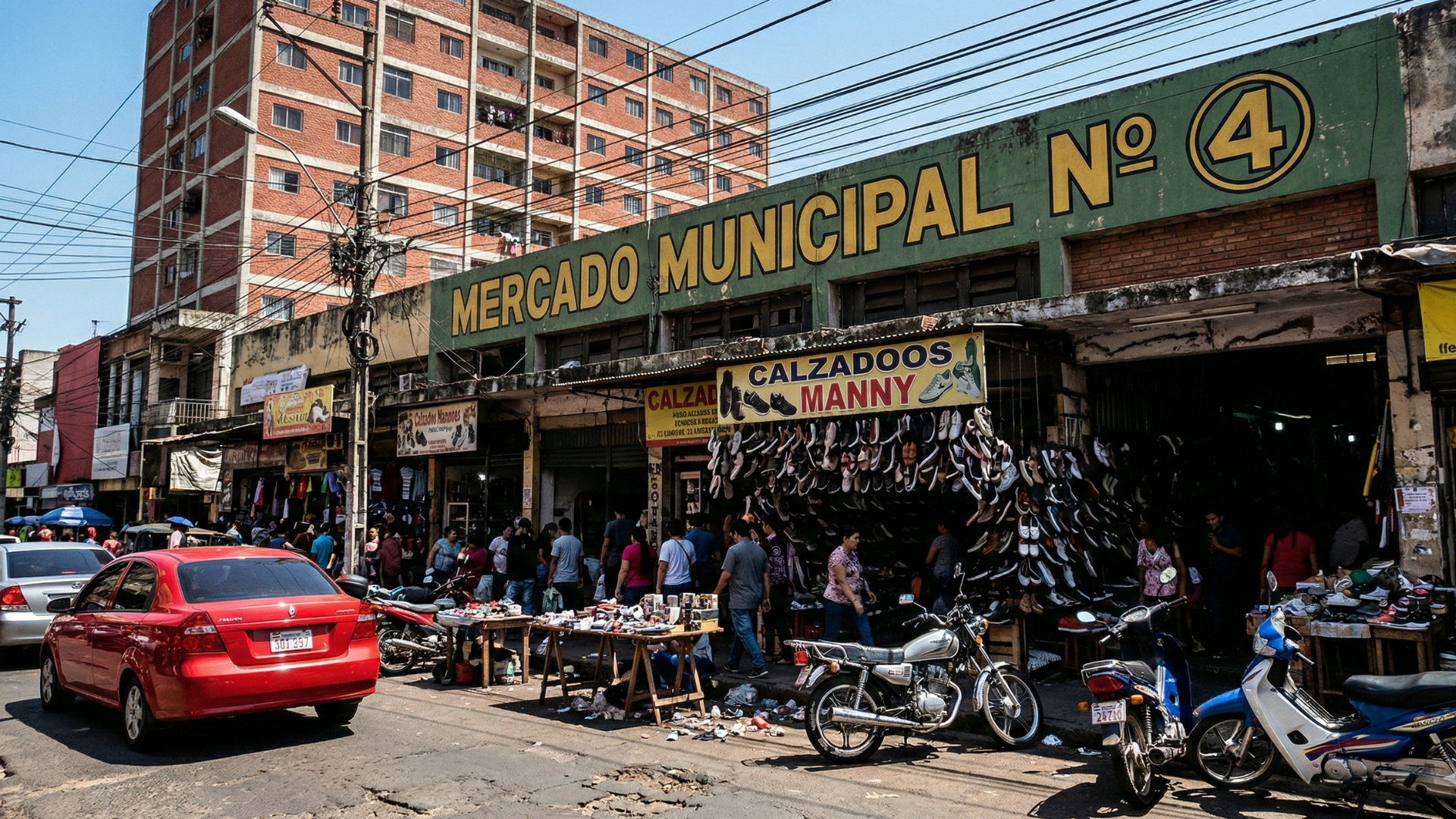
If you came to Paraguay thinking you had already seen everything Asunción has to offer – the museums, the Paraguay River waterfront, the restaurants of Villa Morra – then you haven’t been to the Mercado 4 yet.
Located in the Pettirossi neighborhood, Mercado 4 is the largest open-air popular market in the Paraguayan capital. But calling it simply a “market” is like calling the Amazon a “river”: technically correct, yet completely insufficient.
In reality, this is where Asunción reveals its true personality – no script, no filters, no entrance ticket required.
In its streets and galleries, you’ll hear jopará – the vibrant blend of Guaraní and Spanish – echoing through animated negotiations.
You’ll catch the scent of fresh herbs being crushed in wooden mortars by yuyeras (traditional herbal vendors).
You’ll see meat being deboned just steps away from stalls selling smartphones imported from Asia.
All at once. All real.
Mercado 4 has existed since Asunción was still learning how to be a metropolis. It has survived fires, forced modernization attempts, and pressure from formal retail commerce.
It endured because it is irreplaceable.
This is where everyday Paraguayans shop, eat, work, and keep a living culture alive – one that no shopping mall could ever contain.
Today, we’re going to share essential tips for anyone who wants to truly experience Mercado 4: where to go, what to buy, what to eat, how to stay safe, and – most importantly – how to look beyond the apparent chaos to discover the rhythm, logic, and beauty pulsing on every corner of this unique place.
What Is Mercado 4 – and Why It’s Unlike Anything Else in Paraguay
The Mercado 4 – officially known as Mercado Municipal Nº 4 – is the largest open-air popular market in Asunción and one of the most significant in all of South America.
It spans several city blocks and brings together thousands of vendors operating both inside covered galleries and at open-air stalls lining the sidewalks.
The name has a direct historical origin: it refers to Asunción’s fourth municipal district, an urban division that helped shape the expansion of the Paraguayan capital throughout the 20th century.
Over time, the number became an identity. Today, no one says, “I’m going to the municipal market in Pettirossi.” People simply say: Voy al Cuatro – “I’m going to the Four.”
What sets Mercado 4 apart from any shopping mall, supermarket, or tourist fair is its raw, unfiltered functionality.
It wasn’t built to attract visitors.
It exists to serve everyday Paraguayans. And it’s precisely this lack of “makeup” that makes it so fascinating to outsiders.
Here, within the same block, you’ll find:
fresh fruit brought in from Paraguay’s countryside, smartphones imported from Asia, medicinal herbs ground on the spot, replicas of international fashion brands, freshly butchered meat prepared in plain sight, and humble eateries serving sopa paraguaya for under five dollars.
This layering of worlds – traditional and modern, rural and global, informal and essential – is entirely unique.
Why Visit Mercado 4?
- It’s where Paraguayans from all social classes do their everyday shopping
- It offers some of the most competitive prices in Asunción for electronics, clothing, and food
- It is the largest living repository of Guaraní culture in the capital
- It delivers a food experience impossible to replicate in formal restaurants
- It represents the economic and social history of modern Paraguay in motion
Location and How to Get to the Mercado 4
Mercado 4 is located on Avenida Pettirossi, between Eusebio Ayala and Dr. Moisés Bertoni streets, in the Pettirossi neighborhood – less than 2 km (about 1.2 miles) from Asunción’s historic center.
By Ride-Hailing App (Recommended)
Bolt is the most popular ride-hailing app in Asunción and the most practical way to reach Mercado 4. Uber also operates in the city.
Ask the driver to drop you off on Avenida Pettirossi or near Galería Bonanza, which serves as a central reference point inside the market area.
Avoid driving your own car. Traffic in the area is dense, the streets are narrow, and parking is nearly nonexistent during peak hours.
By Public Transportation
Dozens of bus lines converge around Mercado 4. The area is one of the main public transportation hubs in Asunción.
If you’re staying in the historic center or neighborhoods like Trinidad or Villa Morra, you’ll find direct routes with frequent service.
On Foot
If you’re staying in the historic center, Mercado 4 is about a 20–25 minute walk away. Walking along Avenida Mariscal López offers a good first glimpse into the rhythm of the city.
If you’re staying at ZenGarden Paraguay, the market is also relatively close – about 40 to 50 minutes by car, depending on traffic.
Opening Hours: When to Go (and When to Avoid)
Mercado 4 operates Monday through Saturday, from 7:00 AM to 6:00 PM.
The Golden Window: 8:00 AM to 10:00 AM
The best time to visit Mercado 4 is between 8 and 10 in the morning. During this window:
- Fresh products are at their peak quality
- The heat in Asunción is still manageable (the city can exceed 38°C / 100°F in summer)
- The crowd is lively but still navigable
- Vendors tend to be energetic and in good spirits at the start of the day
10:00 AM to 2:00 PM
This is peak time. Very crowded. Very hot. Still worth visiting – but it requires more energy and patience.
2:00 PM to 6:00 PM
The market begins to slow down. There’s less movement, but some fresh products may already be sold out.
Sundays: Avoid
Most stalls are closed on Sundays, and the area loses much of its characteristic energy and atmosphere.
Market Map: How the Mercado 4 Is Organized
Despite its chaotic appearance, Mercado 4 follows an internal logic shaped over decades.
Understanding its main sectors will save you time – and dramatically improve your first visit.
Herb & Yuyo Sector (Main Entrance)
Near the main entrances along Avenida Pettirossi, the dominant aroma is that of yuyos – medicinal and aromatic herbs essential for preparing tereré and traditional Guaraní natural remedies.
This is the most visually striking sector: colorful stalls, women grinding herbs in large wooden mortars, bottles filled with ready-made herbal blends.
The yuyeras – specialized herbal vendors – are central figures in Paraguayan culture.
They don’t just sell plants; they are guardians of ancestral natural medicine knowledge passed down through generations.
Asking for a blend of “remedios refrescantes” (cooling herbs) for your tereré is the unofficial rite of passage for any visitor to Mercado 4.
Galería San Miguel: Electronics & Technology
Galería San Miguel is the go-to reference point for electronics, smartphones, accessories, and gadgets.
Paraguay has a long-standing tradition of importing Asian products with relatively low taxation, which makes prices competitive compared to Brazil, Argentina, and Chile.
Tips for Buying Electronics at Mercado 4:
- Test all products before leaving the store
- Confirm whether the product includes a seller warranty
- Compare prices at at least three stalls before making a deal
- Brands like Samsung and Xiaomi are generally reliable; be cautious with unknown brands
Galerías Santo Domingo & Pettirossi: Fashion & Footwear
The textile sector is concentrated in Galerías Santo Domingo and Pettirossi.
Here you’ll find football jerseys, athletic shoes, casual clothing, and fashion accessories.
Prices are significantly lower than in formal retail stores.
Handicrafts Sector: Ao Po’i, Leather & Souvenirs
- Ao Po’i: a hand-embroidered textile recognized as part of Paraguay’s Intangible Cultural Heritage
- Handcrafted leather goods: bags, belts, and wallets at prices well below tourist shops
- Ceramics and Indigenous crafts featuring Guaraní-inspired designs
What to Buy at Mercado 4: Category Guide
Fresh Produce & Food
Mercado 4 is Asunción’s primary hub for fresh food supply.
Tropical fruits like mango, passion fruit, pineapple, and papaya arrive directly from Paraguay’s countryside. Prices are lower than supermarkets, and quality is typically excellent.
Don’t miss Paraguayan spices such as colorau (annatto), cumin, and various local peppers sold in bulk at extremely low prices.
Tereré & Medicinal Herbs – What to Pack in Your Suitcase
- Ka’a (yerba mate for tereré)
- Pre-mixed herbal “remedios” for tereré
- A guampa (traditional drinking vessel) made of wood or bull horn
- A bombilla (metal filtering straw)
Leather Goods & Traditional Handicrafts
Genuine leather products at fair prices and authentic Ao Po’i pieces are among the most recommended souvenirs to bring home from Paraguay.
Food at the Mercado 4: What to Eat and Where
Eating at Mercado 4 is an experience in itself.
Any visitor who walks in hungry and leaves full for less than five dollars quickly understands why this place is the beating heart of Asunción.
Essential Paraguayan Dishes to Try at Mercado 4
Chipa
The iconic Paraguayan staple. A cheese bread made with cassava flour (tapioca starch) and Paraguayan cheese, traditionally baked in a wood-fired oven.
The market version is denser and more flavorful than industrialized varieties – made with pork fat and local cheese for a richer taste.
Sopa Paraguaya
The name is misleading: it’s not a liquid soup. It’s a dense, savory cornbread made with cornmeal, Paraguayan cheese, onions, and animal fat.
It’s one of the pillars of traditional Paraguayan cuisine.
Vori Vori
A thick soup with small cornmeal-and-cheese dumplings simmered in broth.
This is Paraguay’s ultimate comfort food – served hot in the market’s humble eateries.
Beef Empanadas
Fried to order and filled with seasoned ground beef. A dozen costs less than 20,000 guaraníes.
Mbeju
A flatbread made from tapioca starch and cheese, toasted on a griddle.
It pairs perfectly with cocido – a hot drink made from burnt yerba mate, sugar, and milk – especially popular on cold Asunción mornings.
Pira Caldo
A traditional river fish soup, one of the oldest recipes in Guaraní cuisine.
Typically prepared with surubí or dorado, seasoned with cilantro and local peppers.
Where to Eat: Practical Guidance
The Municipal Dining Area (in the central sector of the market) concentrates most of the traditional comedores populares.
Full meals typically cost between 25,000 and 40,000 guaraníes – approximately 3 to 5 USD (2025 reference).
Chipa usually ranges from 2,000 to 5,000 guaraníes.
Safety at Mercado 4: Practical and Real Tips
Mercado 4 is safe for the vast majority of visitors.
The most common risk is pickpocketing in crowded areas — not violent crime. Basic awareness and common sense are enough for a smooth visit.
Safety Checklist for Visiting Mercado 4
- Bring cash in small guaraní notes. Most stalls do not accept cards. Bills of 10,000, 20,000, and 50,000 make transactions easier.
- Avoid displaying valuables. Brand-name watches, gold chains, and professional cameras increase unnecessary risk.
- Wear your backpack in front or use a money belt. During peak hours, carry your backpack on your chest or use a concealed pouch under your clothes.
- Stay mindful of your phone. Keep it in your front pocket. Avoid prolonged public use.
- Ask permission before photographing. Buy something small, start a conversation, and then politely ask before taking photos.
- Stay hydrated. Asunción’s heat is intense between October and March. Buy water or tereré shortly after arriving.
- Be cautious with unsolicited guides. Politely decline anyone who approaches offering services with unexpected fees.
What NOT to Do at Mercado 4
- Don’t argue aggressively or disrespectfully over prices
- Don’t enter dark galleries or dead-end alleys alone on your first visit
- Don’t leave bags unattended
Mercado 4 and the Cultural Identity of Asunción
To understand Mercado 4 is to understand Paraguay.
No museum or official city tour conveys the essence of Paraguayan life with the same intensity as a single morning inside Mercado 4.
The Rural–Urban Connection the Market Keeps Alive
During the 1970s and 1980s, rural migration reshaped Asunción. Families moving from departments such as San Pedro, Caaguazú, Paraguarí, and Concepción found in Mercado 4 both a source of income and a cultural anchor.
The Guaraní language remained alive in part because Mercado 4 functioned as a space where jopará – the fluid blend of Guaraní and Spanish – became the natural language of everyday commerce.
Walking through the market and hearing jopará is a unique linguistic experience: the audible equivalent of watching a living language refuse to disappear.
The Yuyeras: Guardians of Ancestral Knowledge
The yuyeras of Mercado 4 are far more than herb vendors.
They are guardians of a natural medicine system that traces back to pre-colonial Guaraní cosmology.
Each plant serves a specific purpose:
burrito for digestion, typycha for fever, ambay for cough, cedrón for anxiety.
This knowledge has been transmitted orally, from mother to daughter, for generations.
Socioeconomic Impact
Mercado 4 is estimated to generate direct income for tens of thousands of families – including fixed vendors, street sellers, porters, suppliers from the countryside, and service providers.
For many, it is their only source of income.
Mercado 4 vs. Other Popular Markets in South America
What distinguishes Mercado 4 is a rare combination: scale, authenticity, functionality, and resistance to gentrification.
Unlike La Boqueria in Barcelona or Mercado Central de Santiago – both of which have evolved into major tourist attractions with corresponding prices – Mercado 4 remains a living organism that operates primarily for Paraguayans.
It has not been redesigned for visitors. It has not been sanitized for international consumption.
And that is precisely why it matters.
| Market | City | Profile |
| Mercado 4 | Asunción, PY | Functional, authentic, non-touristic, deeply Guaraní |
| Mercado Central de Buenos Aires | Buenos Aires, AR | Partially touristic, well-structured |
| La Boqueria | Barcelona, ES | Highly touristic, inflated prices |
| Mercado Central de Santiago | Santiago, CL | Mixed: tourists + locals, seafood-focused |
| Mercado de Surquillo | Lima, PE | Functional, popular, less touristic |
Here’s a natural English translation of your FAQ and accommodation section, keeping it reader-friendly and fluid for international audiences:
Frequently Asked Questions About Mercado 4
Is Mercado 4 safe for tourists?
Yes. The main risk is pickpocketing in crowded areas, not violent incidents. Wearing discreet clothing, carrying your backpack in front, using small bills in guaraní, and staying aware of your phone are the key precautions.
What is the best time to visit Mercado 4?
Between 8:00 AM and 10:00 AM, Monday to Saturday. Fresh products are at their peak, the heat is manageable, and crowds are navigable. Avoid Sundays, as most stalls are closed.
How do I get to Mercado 4 in Asunción?
The most practical option is via the Bolt app. Request a ride to Avenida Pettirossi or Galería Bonanza as a reference point. Driving your own car is not recommended.
Do vendors accept credit cards?
No. The vast majority operate exclusively with cash in guaraní. Bring bills of 10,000, 20,000, or 50,000 guaraní.
How much does it cost to eat at Mercado 4?
Full meals cost 25,000–40,000 guaraní (~$3–$5 USD in 2025). Chipas range from 2,000–5,000 guaraní.
What is tereré and where can I try it?
Tereré is Paraguay’s national drink: yerba mate consumed cold with ice water, citrus juice, and fresh herbs. The yuyeras in the Herb & Yuyo sector on Avenida Pettirossi prepare custom blends on the spot.
Can I bargain at Mercado 4?
Yes. Haggling is part of the culture and expected by vendors. The key is to do it politely and with good humor.
What are the best items to buy at Mercado 4?
Herbs for tereré and guampas, Ao Po’i handicrafts, artisanal leather goods, bulk spices, fresh tropical fruits, and traditional foods like chipa and sopa paraguaya.
Is Mercado 4 open on Sundays?
Not meaningfully. Most stalls are closed. The best days to visit are Monday through Saturday.
What is Ao Po’i?
Ao Po’i is hand-embroidered fabric, recognized as Paraguay’s Intangible Cultural Heritage. Produced in Itauguá and Guarambaré, it appears in towels, clothing, bags, and decorative items.
Are there vegetarian or vegan options?
Yes. Fresh fruits, chipas, vegetables, and herbs are widely available. Tropical fruits at low prices are an excellent choice for those avoiding meat.
Where to Stay to Make the Most of Asunción
Exploring Mercado 4 and the best of Asunción requires a comfortable, peaceful, and well-located base – and that’s exactly what ZenGarden Paraguay offers.
Unlike conventional hotels, ZenGarden is a true residential sanctuary: gardens, purified water throughout the property via reverse osmosis, reliable internet, and accommodations that combine European design with South American soul.
Choose your ideal stay:
- Casa Orchid – perfect for families or couples seeking privacy
- Casa Colibri – ideal for digital nomads needing focus and comfort
- Bungalow Bananita – a tropical retreat for those who want to truly relax
With a 5-star Google rating and guests who return for weeks, not just days, ZenGarden is the right choice for experiencing Paraguay deeply – not just passing through.
📲 Contact via WhatsApp to secure your stay: (0972) 817046
Conclusion
Visiting Mercado 4 is an immersion into the real Paraguay – not the polished version for tourists, but the everyday life of a capital city that pulses with its own distinctive energy.
It’s noisy, it’s hot, it smells of herbs and roasted meat, it resonates with a mix of Guaraní and Spanish, and at every corner it offers proof that a culture reveals itself first and foremost in the way people buy, sell, eat, and converse.
For visitors willing to look beyond the surface, Mercado 4 delivers an experience that no museum or official tour can replicate.
With simple planning – arrive early, bring cash in guaraní, dress discreetly, and come hungry – a morning at Mercado 4 becomes one of the most vivid memories of any trip to Asunción.
Comments are closed